



Blogs
A Beginner’s Complete Guide to Surfing in Ireland (2026 Edition)

Every surfer in Ireland started exactly where you are now — standing on a beach, wetsuit on for the first time, wondering if this is going to be as hard as it looks.
It is, a little. And it’s also more achievable in a single morning than most people expect. This guide covers everything a first-time surfer actually needs to know before booking a lesson in Ireland — what to expect, what gear you need, how the water actually feels, and how to pick where to learn.
Yes, the Water Is Cold — Here’s What That Actually Means
Ireland’s Atlantic coast doesn’t get warm the way people imagine when they think of surfing. Water temperature ranges from around 8-10°C in winter to 14-16°C at its warmest in late summer. That’s cold by most standards.
The good news: a proper wetsuit makes this a non-issue. A 4-5mm full wetsuit keeps you comfortable for a full session. Every reputable surf school in Ireland — including Atlantic Surf School — provides wetsuits, boots, and boards as standard. You don’t need to own any of this, and you don’t need to worry about the cold before you’ve even tried it.
What surprises most first-timers isn’t the cold — it’s how quickly you stop noticing it once you’re focused on catching a wave.
What a First Lesson Actually Looks Like
A typical beginner lesson runs around 2.5 hours, and it’s not two and a half hours of falling off a board in the ocean. The structure matters.
On the sand first. Before anyone enters the water, a good instructor spends real time on land — how to lie on the board, how to paddle, how to pop up into a standing position, and how to read an incoming wave. This isn’t a formality. Getting the pop-up motion right on sand, where nothing is moving, makes the actual water session dramatically easier.
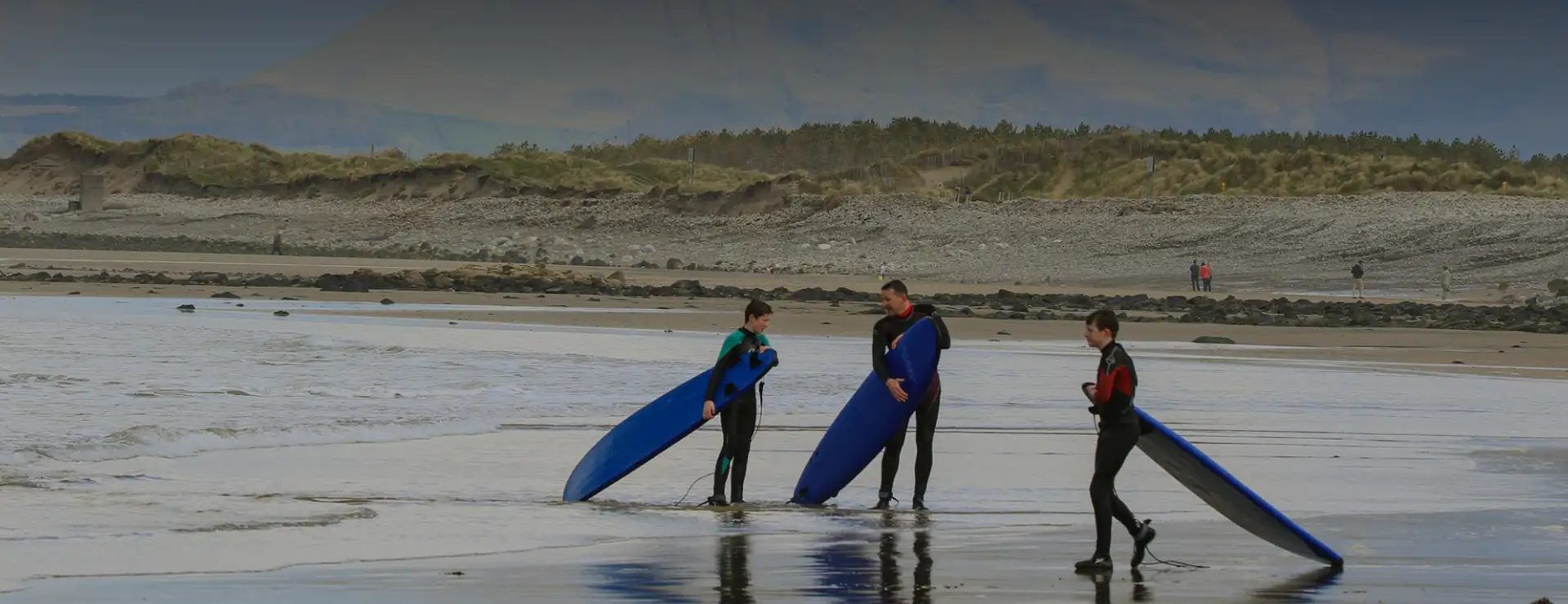
Then in the water, with support. Beginner lessons use large, stable soft-top boards — nothing like the short, sharp boards experienced surfers use. Your instructor stays in the water with you, positioning you for waves and often giving your board a push at exactly the right moment to help you catch it.
Most people stand up on day one. Not every wave, and not perfectly. But the combination of proper technique instruction, the right equipment, and consistent beginner-friendly waves means most first-timers catch at least one wave and stand, however briefly, in their first session.
What to Bring (and What Not To)
Bring: Swimwear, a towel, and a willingness to fall over repeatedly without taking it personally.
Don’t bring: Your own board or wetsuit unless a school specifically asks you to. Beginner-specific equipment is calibrated for learning, not for looking good, and schools provide it as standard.
Don’t worry about: Being unfit, a bad sense of balance, or never having been in the ocean before. Surf instructors teach complete beginners every day. The lesson is built for exactly this starting point.
Choosing Where to Learn
Ireland’s west coast has several well-known surf towns, each with a slightly different character.
- Strandhill, Co. Sligo — Consistent, sandy beginner conditions and a purpose-built National Surf Centre with proper facilities. A compact village where everything is within walking distance.
- Bundoran, Co. Donegal — A bigger, more established surf town with more shops and nightlife, though some of the well-known breaks near town are less consistently beginner-friendly.
- Lahinch, Co. Clare — Long sandy beach with deep surf culture, close to the Cliffs of Moher, though further from Dublin and busier in peak season.
For a genuine first lesson with the fewest variables, a spot with consistent, sandy conditions — like Strandhill — tends to be the most straightforward choice. But any of these towns will get you standing on a wave with the right instruction.
The One Safety Rule That Matters Most
Wherever you learn, understand this: the same currents that make a beach good for surfing usually make it dangerous for casual, independent swimming. Beaches like Strandhill are surf beaches, not swimming beaches — the strong, consistent currents that create rideable waves are exactly what makes unsupervised swimming risky.
This is why lessons with certified instructors matter beyond just learning technique. An ISA-certified instructor understands the specific conditions of that beach on that day — tide, swell direction, wind — and puts you in the water at the right time, in the right place. Always learn with certified instruction, regardless of which beach you choose.
Realistic Expectations for Your First Few Sessions
Session one: Learning to read a wave, pop up, and probably catching one or two waves properly. Expect to be tired in a way that surprises you — surfing works muscles you don’t normally use.
Sessions two and three: Better timing, fewer wipeouts, and starting to feel the difference between a wave worth catching and one to let pass.
A surf camp (multiple sessions over consecutive days): This is genuinely the fastest way to progress. Muscle memory builds quickly with consecutive days in the water, and most people who do a camp format leave with real, transferable surfing ability rather than a single good memory.
Frequently Asked Questions
Do I need to be fit to learn to surf? No specific fitness level is required for a beginner lesson. Surfing does use muscles that aren’t part of most daily routines, so expect some soreness afterward, but instructors work with complete beginners of all fitness levels regularly.
Is surfing in Ireland actually good, or is it just cold? Ireland’s west coast has genuinely excellent surf conditions — consistent Atlantic swell, several world-recognised beaches, and a real surf culture in towns like Strandhill, Bundoran, and Lahinch. The cold water is real, but a proper wetsuit resolves it almost entirely.
What’s the best time of year for a beginner to learn? June through September offers the most consistent, gentle conditions for first-timers, along with warmer air temperatures. Ireland has surfable waves year-round, but summer is the easiest starting point.
How many lessons does it take to actually learn to surf? Most people can stand up and catch a basic wave in their first lesson. Genuinely learning to surf — reading waves independently, positioning yourself, catching waves consistently — takes several sessions, which is why multi-day surf camps tend to produce faster progress than a single lesson.
Can I learn to surf if I’ve never been comfortable in the ocean? Yes. Beginner lessons take place in shallow water on stable boards, with an instructor beside you throughout. It’s a controlled, supported environment specifically designed for people without ocean experience.
Do I need my own wetsuit and board to start? No. All reputable surf schools, including Atlantic Surf School, provide wetsuits, boots, and boards as part of every lesson. You only need swimwear and a towel.
Atlantic Surf School is based at the National Surf Centre, Shore Rd, Strandhill, Co. Sligo. Book your first lesson here.
Written by Zuhé Coronil, founder of Atlantic Surf School, who has 16 years of surfing experience and has taught complete beginners for years in Strandhill.
